Best Kettlebell Workouts for Beginner Women


Short on time but ready to get stronger? One kettlebell can cover a lot of ground at home, if you choose a routine that matches your skill and your day. Here are 10 beginner-friendly kettlebell workouts, with time, gear, effort level, and a clear next step for each.
1. 15-Minute Full-Body Starter Circuit
This short kettlebell workout for beginners pairs simple strength moves with brief work periods. It suits you when you have a small window and want to practice more than one movement pattern.
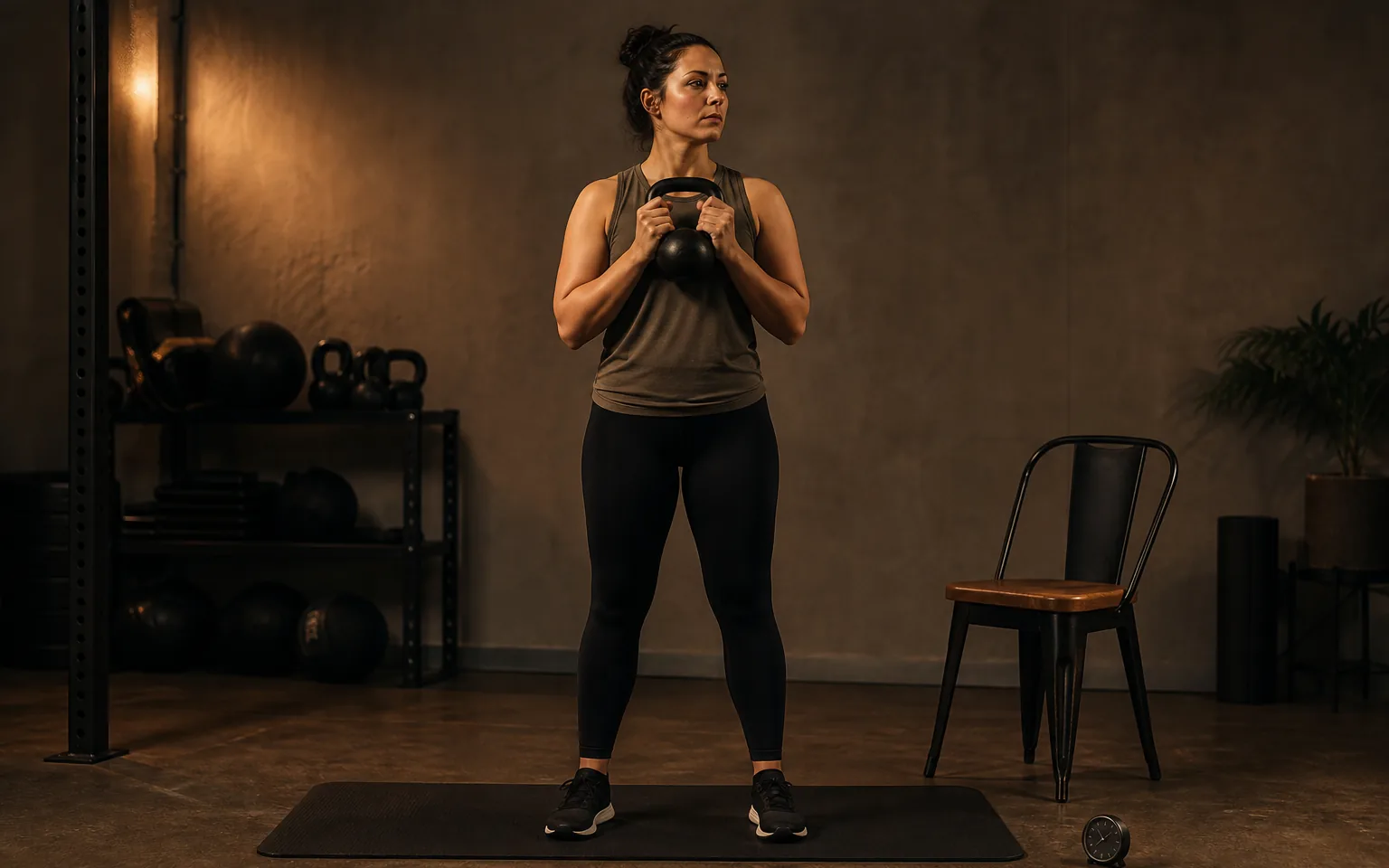
Time: 15 minutes, plus a short warm-up. Gear: one light-to-moderate kettlebell, a mat, and an optional sturdy chair for support. Difficulty: beginner, provided you already know the basic moves.
Set a timer for 30 seconds of work, then rest for 30 seconds. Alternate goblet squats with deadlifts for the first few rounds. If your swing form is already steady, you can add a small set of two-hand swings after a strength move. Otherwise, repeat deadlifts instead. The workout should leave room to focus on control, not force you to rush a new skill.
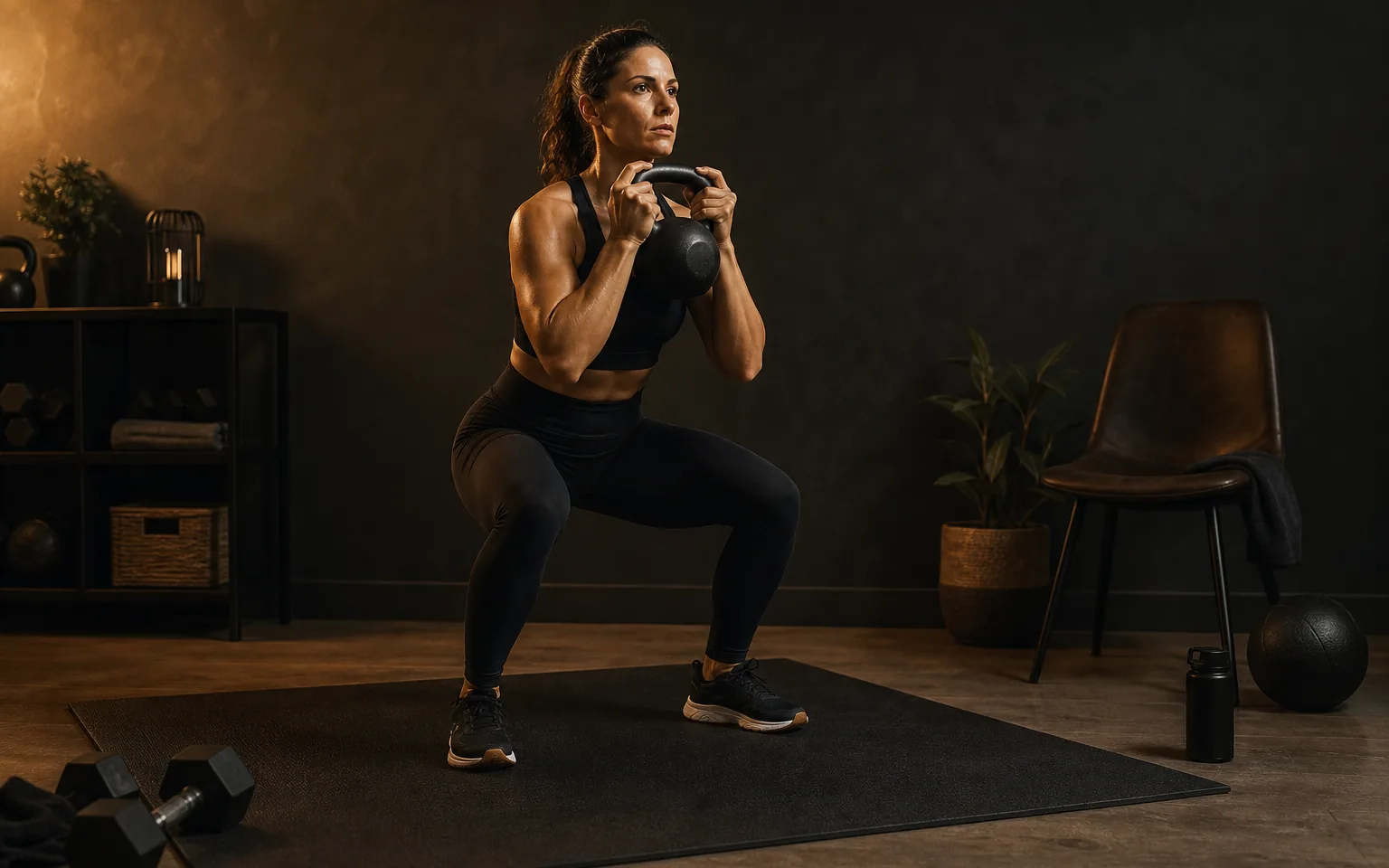
For squats, keep the bell close to your chest and let your knees follow the line of your toes. For deadlifts, push your hips back as if closing a drawer with them. Keep your back long. Kettlebell training can combine strength and cardio demands, but your pace and movements determine how hard the session feels.
Progression: First make each rep smooth. Then add one round or a few reps while keeping the same rest. If your form slips, shorten the work period instead.
This option works best when you have practiced each move outside the timer. A timer is useful for pacing, not a reason to move faster than you can control.
2. 20-Minute Goblet Squat and Deadlift Strength Set
This strength set keeps the focus on two core kettlebell moves: the goblet squat and deadlift. It is a good fit if you want to build confidence with the main lower-body patterns before trying faster circuits.
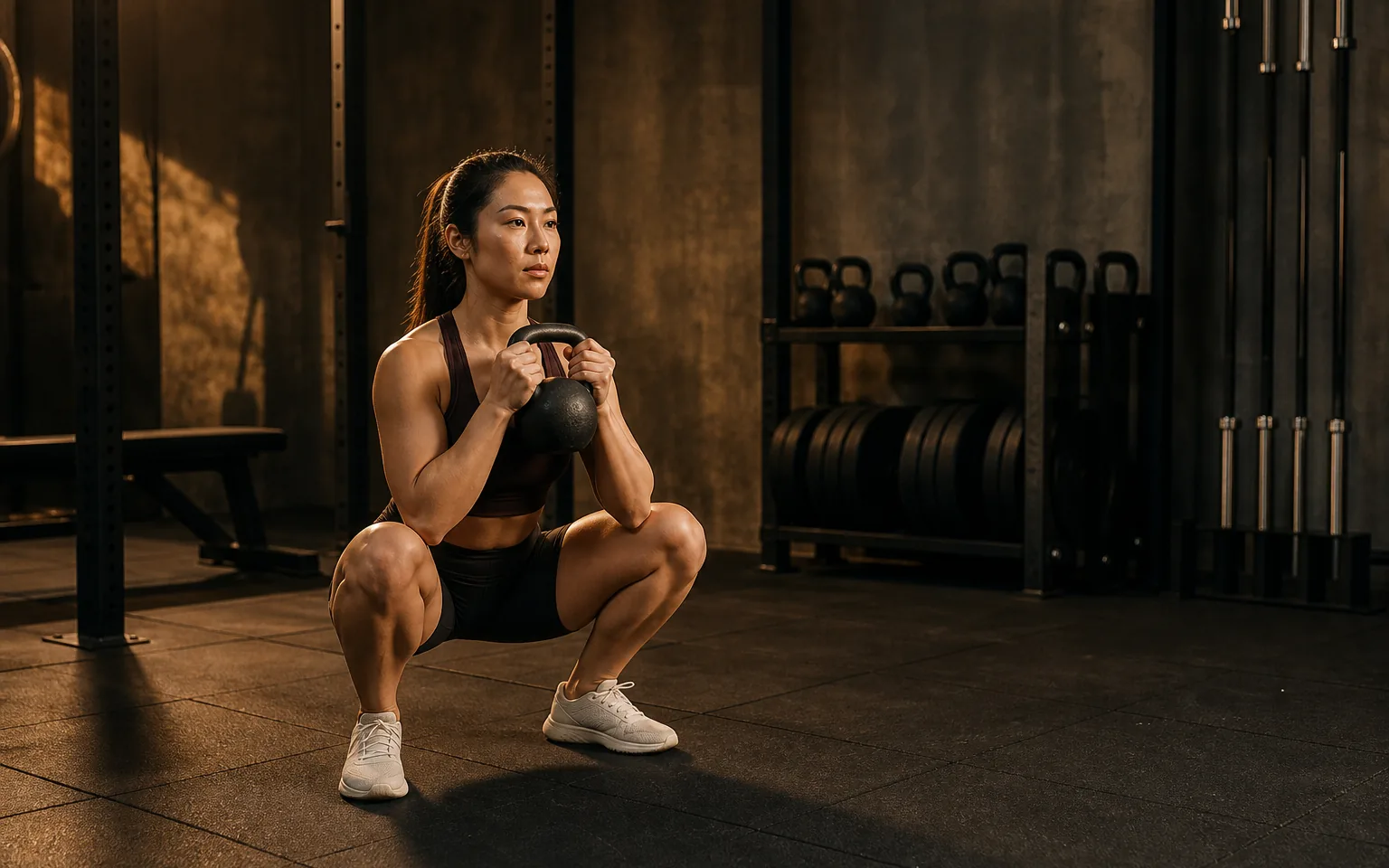
Time: 20 minutes. Gear: one kettlebell and a clear patch of floor. Difficulty: beginner. Start with a weight you can lift without changing your posture or grip.
Warm up for about five minutes with easy marching, arm circles, and bodyweight hip hinges. Then do three rounds of 8 goblet squats and 8 deadlifts. Rest for 45 to 75 seconds between rounds, or longer if you need to catch your breath. In the squat, hold the bell close at chest height, sit between your feet, and stand by pressing through the whole foot. In the deadlift, the hips move back first. The bell stays close to your legs.
Squats mainly train the thighs and glutes. Deadlifts load the glutes and hamstrings while teaching a hinge pattern. The deadlift is a compound move that works several muscle groups. Keep the motion neat; a heavier bell is not worth losing your back position.
Progression: When all reps feel steady, add a set before you add load. Another option is to lower the bell more slowly on each rep. That makes the set harder without turning it into a race.
Choose this workout on days when you want strength practice and don’t need a long list of exercises. The pair is simple by design.
3. Beginner Hinge-and-Swing Skill Session
This session puts the hinge first and the swing second. It is for you if you want to learn where swing power comes from before adding it to a timed circuit.
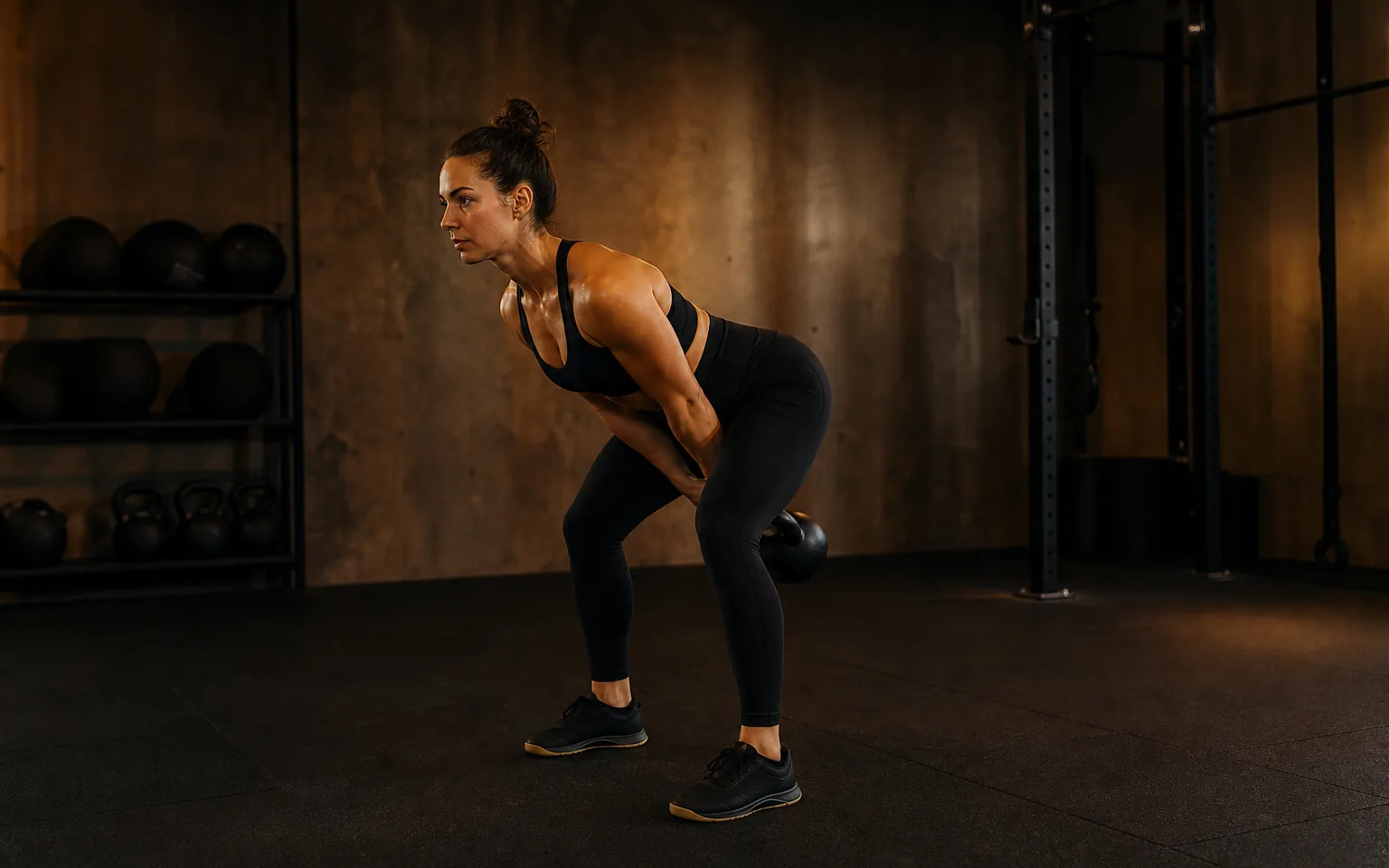
Time: 15 to 20 minutes. Gear: one light kettlebell and open floor space. Difficulty: beginner for the hinge drills; the swing is a next step, not a must-do.
Start with two sets of 8 kettlebell deadlifts. Stand with the bell between your feet, soften your knees, and send your hips back. Keep your spine long and stand by squeezing your glutes. Next, practice 6 to 8 unloaded hip hinges. Reach your hips behind you, then stand tall without leaning back at the top.
Only add two-hand swings if the hinge feels repeatable. Do five small sets of 5 swings, resting between sets. The bell should travel because your hips snap forward; your arms guide it rather than lift it. Keep the bell path close on the backswing. If it drops low and pulls your shoulders down, pause and return to deadlifts.
Progression: Add a few clean swings per set only when you can finish without rounding your back or lifting with your shoulders. Don’t add speed and reps at once.
Skip swings if you’re unsure of the hinge. Deadlifts still train the backside of your body and build the skill the swing depends on.
4. Upper-Body Press-and-Row Workout
This routine pairs a one-arm press with a supported row, so you can train your shoulders and upper back without adding complex moves. It suits you when you want a short upper-body day or a break from repeated squats.
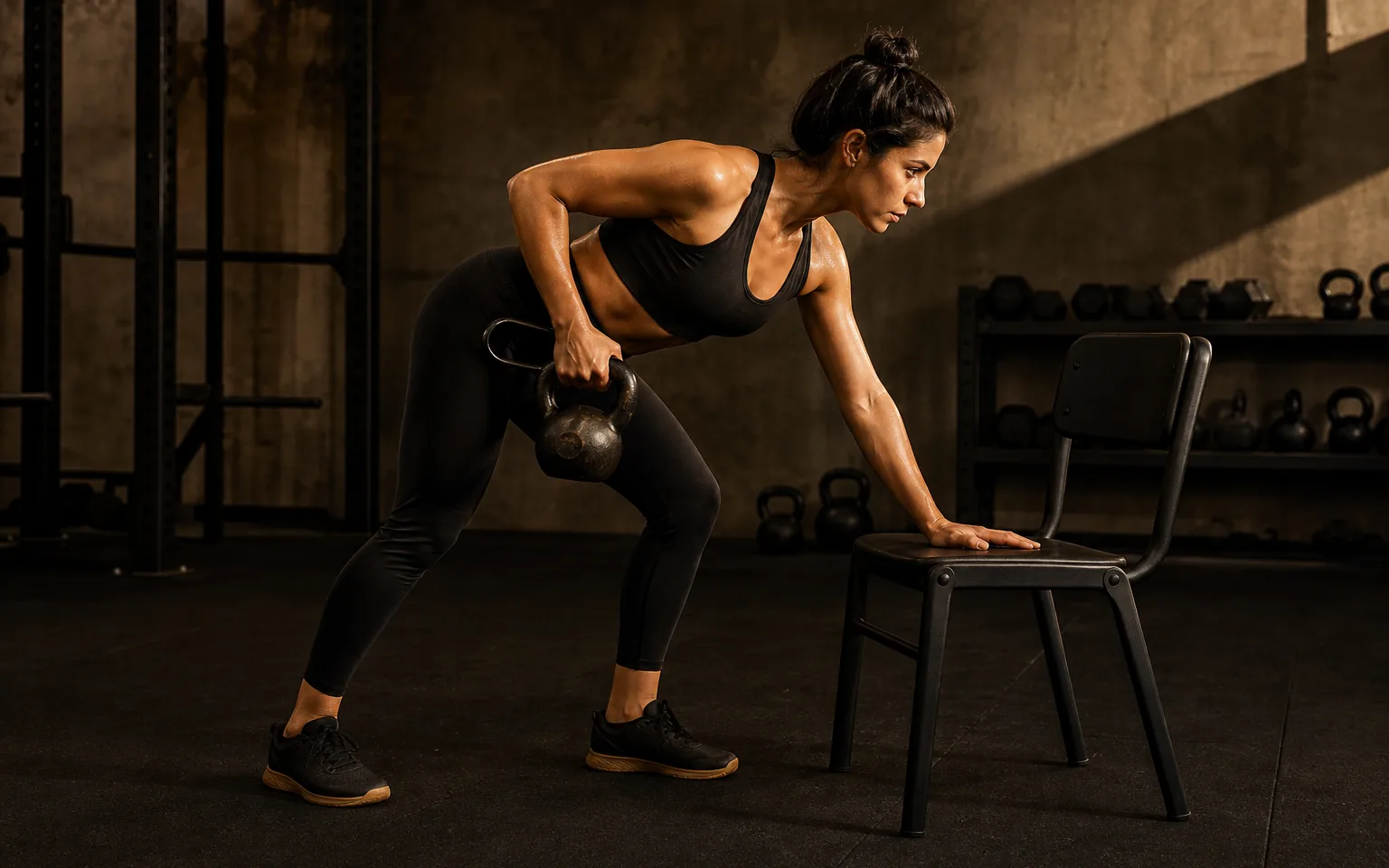
Time: 15 to 20 minutes. Gear: one kettlebell and a stable chair or bench for hand support. Difficulty: beginner to moderate, depending on the press load.
Warm up with shoulder rolls and several unweighted presses. Do 3 rounds of 6 to 8 presses per side, followed by 8 to 10 rows per side. Rest about a minute after each round. For the press, hold the bell at shoulder height, brace your middle, and press overhead only if you can keep your ribs from flaring. For the row, put one hand on the chair, hinge forward, and draw your elbow toward your hip. Lower the bell slowly.
The press works the shoulder and triceps. The row trains the back of the shoulder and upper back, with the arm helping pull the bell. Your torso also has to stay still, especially during one-sided work. If overhead motion feels uncomfortable, replace the press with a lighter floor press or a front raise without a kettlebell.
Progression: Add one or two reps per side before increasing the bell size. Pressing strength often lags behind lower-body strength, so use a lighter weight for this move if needed.
A chair is there to make the row more stable, not to support a wobbly seat. Check it before you lean on it.
5. Low-Impact Chair-Supported Circuit
This circuit uses support and controlled reps to keep balance demands lower. It may suit you if standing balance, deep squats, or floor transfers are hard right now. It is joint-friendlier by design, but stop if a move causes pain.
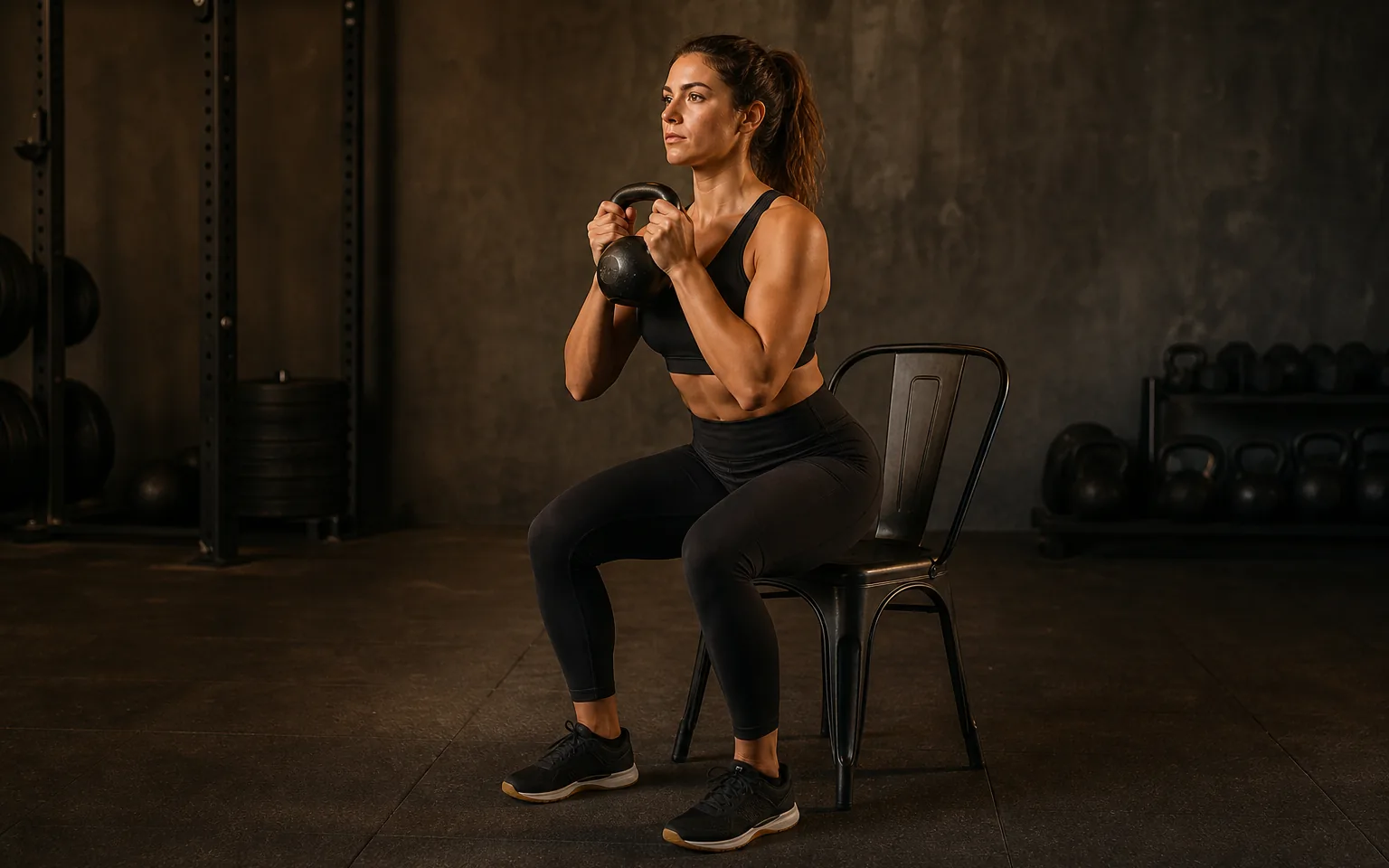
Time: 15 to 20 minutes. Gear: a sturdy chair, one light kettlebell, and a mat if you plan to do floor work. Difficulty: easy to moderate.
Try 2 to 3 rounds of 8 chair-assisted sit-to-stands, 8 supported deadlifts, 8 rows per side, and 10 glute bridges. Use the chair to steady yourself during sit-to-stands or as a hand rest for rows. Keep the kettlebell on the floor for the hinge unless you can lift it with a flat back. For a lower-impact choice, leave out swings and lunges. You can also shorten the squat depth.
The sit-to-stand trains the thighs and glutes in a familiar range. Rows work the upper back. Bridges target the glutes and hamstrings while you lie on your mat. Breathe out as you stand or lift your hips; breathe in as you lower. Keep the effort at a level where you can still control each rep.
Progression: Start by adding a few reps or one round. Later, use the light kettlebell for sit-to-stands if the chair height and your balance make that safe. You can hold a dumbbell instead if its shape feels easier to manage.
If you have a known joint issue, a recent injury, or ongoing pain, ask a qualified health professional which range of motion is right for you.
6. 60/30 Work-Rest Full-Body Session
This workout uses one minute of work followed by 30 seconds of rest. It suits you if you like a steady clock but need more breathing room than a continuous circuit.
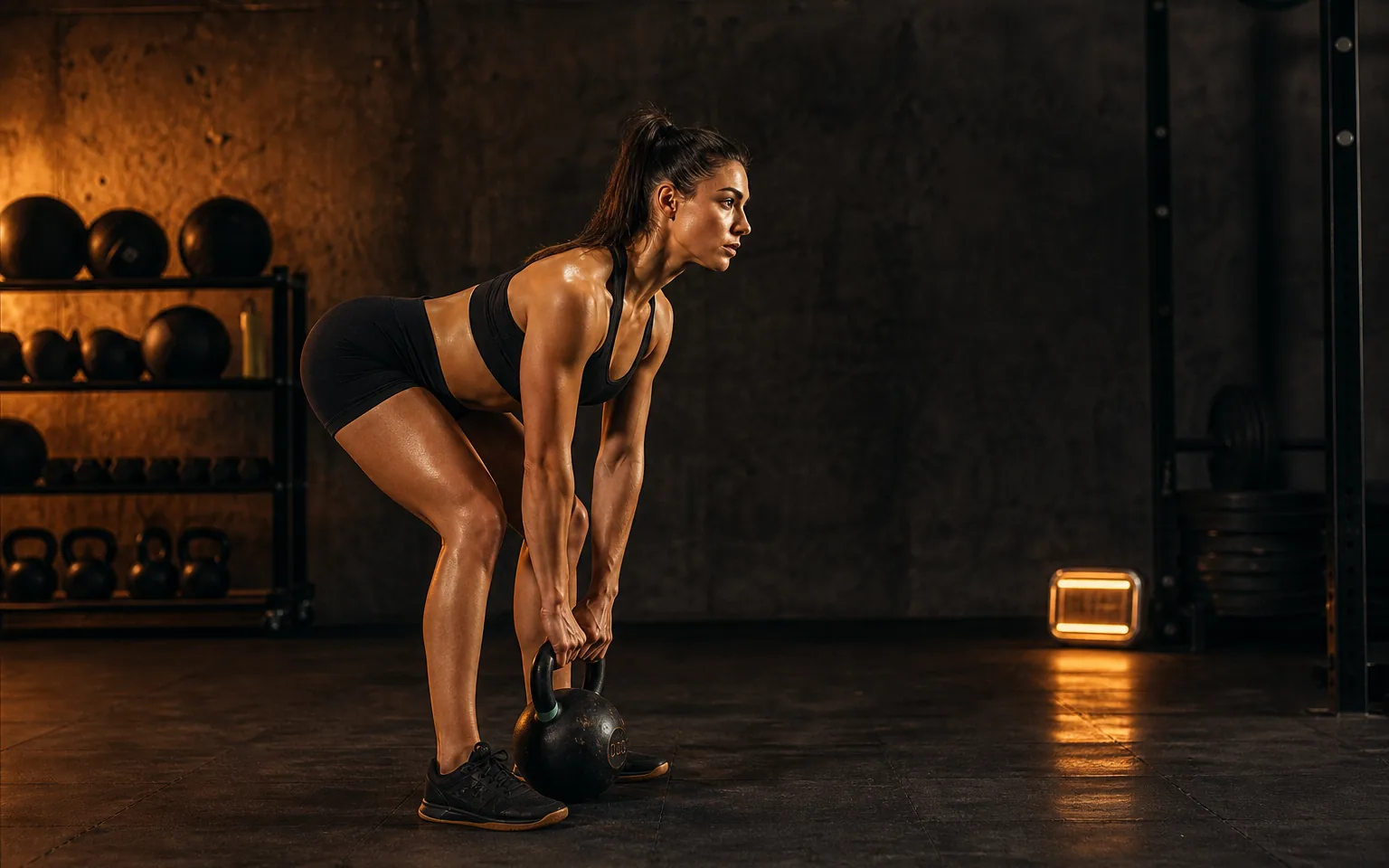
Time: About 9 minutes for one round of six intervals, or 18 minutes with a second round. Gear: one kettlebell, a timer, and optional mat. Difficulty: beginner, with the option to use bodyweight for any move.
Set six stations: deadlift, goblet squat, supported row, glute bridge, floor press, and a standing march while holding the bell at your side. Work for 60 seconds, then rest for 30. Complete one round. If you’re new to timed sets, complete only four stations or work for 30 seconds and rest for 30.
Move at a pace that leaves you able to keep your back and shoulders in place. The work block is not a test of how many reps you can cram into a minute. For a row, switch arms halfway through. For a floor press, lie down with your knees bent and keep the bell close to your chest as you lower it under control.
Progression: Add a second round when the first feels manageable. If that takes too long, keep one round and add a few seconds of work to each station instead.
Use a lighter bell for the press or march if your legs can handle more weight than your upper body. One weight does not have to suit every move equally.
7. Beginner EMOM Workout
An EMOM means “every minute on the minute.” You start a set at the top of each minute, then rest for whatever time remains. This kettlebell routine works for beginners who want a clear start and stop.
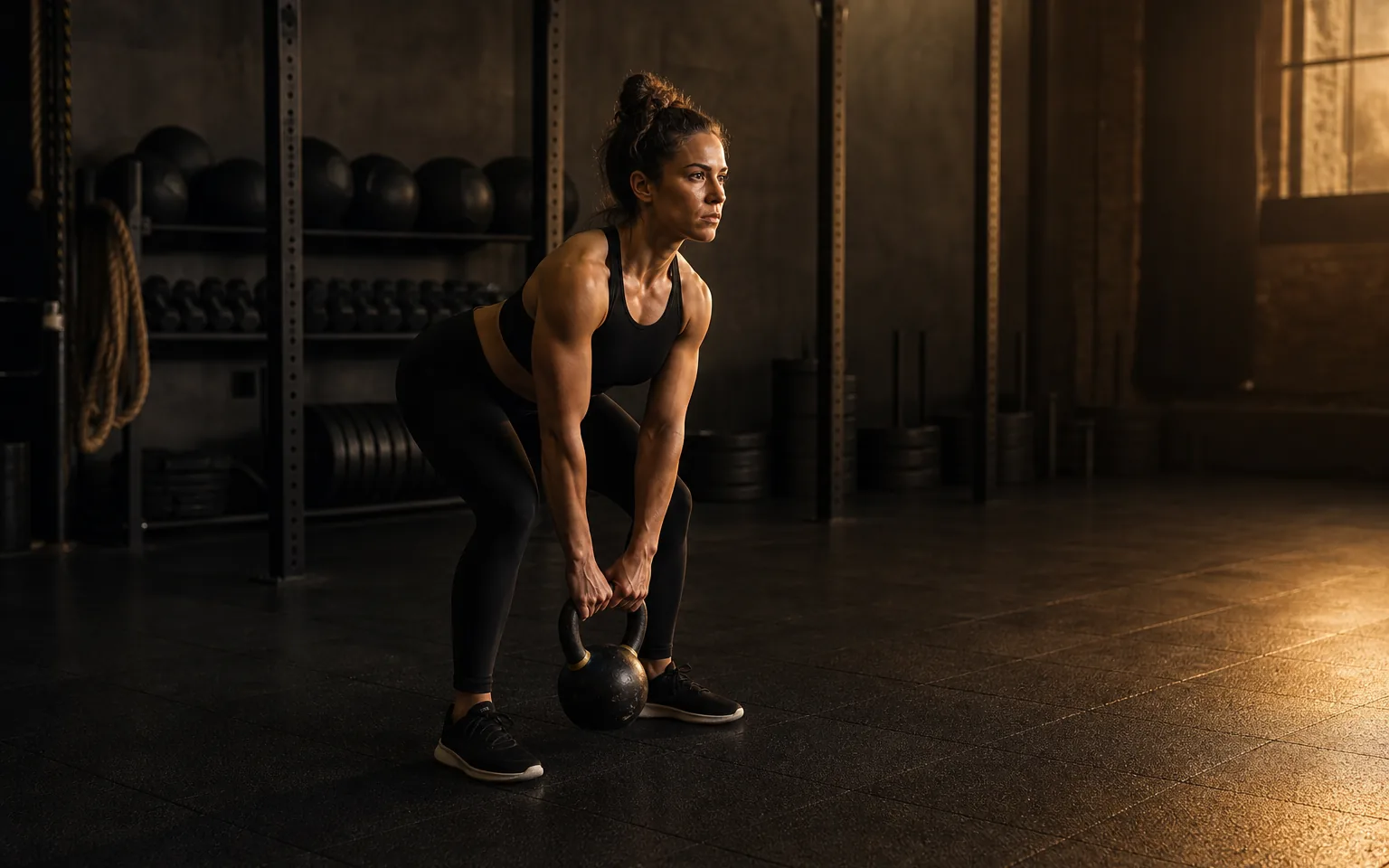
Time: 15 minutes. Gear: one kettlebell and a timer. Difficulty: beginner if you keep the reps low and use familiar moves.
Use this five-minute cycle three times: minute one, 8 deadlifts; minute two, 6 goblet squats; minute three, 6 supported rows per side; minute four, 6 glute bridges; minute five, rest. If a set takes 40 seconds, you get 20 seconds to reset. If you need the full minute, lower the reps or use a lighter bell. Keep a little rest in each work minute; it helps you start the next set with control.
EMOMs can make a busy session easier to plan because the clock sets the pace. But a fixed minute does not mean you need to finish every set. Put the bell down when your form changes. The goal is clean practice, not finishing first.
Progression: Repeat the same workout for several sessions. Add one rep to a set only when you still have time to rest. You can also add a fourth cycle, but keep the same movement quality.
For your first try, use a chair-supported row and leave out swings. A predictable set is a better place to learn than a fast one.
8. 12-Minute Beginner AMRAP
AMRAP means “as many rounds as possible” within a set time. For beginners, the useful part is the steady loop, not chasing a score at the expense of form.
Time: 12 minutes. Gear: one light kettlebell and a timer. Difficulty: beginner to moderate. Choose moves you can do safely when you’re a little tired.
Set up a small loop: 8 deadlifts, 6 goblet squats, 6 rows on each side, and 8 bodyweight reverse lunges or supported split squats per side. Repeat at a calm pace for 12 minutes. If lunges feel unsteady, replace them with 8 chair sit-to-stands. Rest whenever you need to. Count full rounds plus any extra reps, but treat the count as a note, not a grade.
The point of an AMRAP is to repeat a known set of movements within a time limit. The term can mean rounds or reps, depending on the structure. For this session, count rounds. Keep the bell close to your body during deadlifts and squats, and take a breath before each new move.
Progression: Repeat the same workout later and aim for smoother reps before you aim for another round. If you complete more work with the same load and clean form, that’s useful progress.
Don’t use this format to learn swings, cleans, or snatches. A moving clock can make new skills feel more rushed than they need to be.
9. Glutes-and-Core Bridge Workout
This floor-based routine trains the hips and trunk with bridges, a dead bug, and a supported plank. It suits you when you want focused work without a long standing circuit.
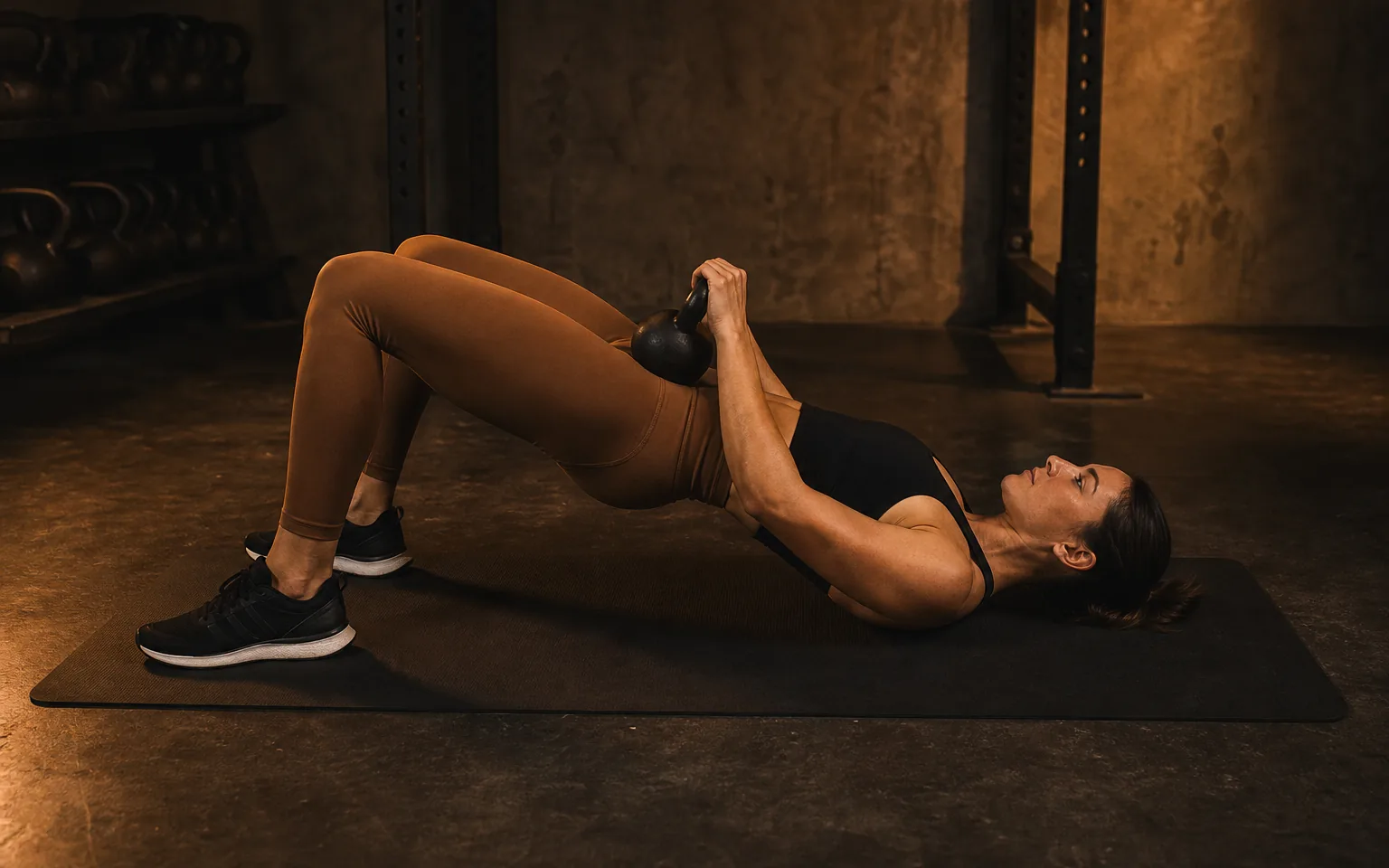
Time: 15 to 20 minutes. Gear: a mat and an optional light kettlebell. Difficulty: beginner, with bodyweight versions for every move.
Complete 3 rounds of 10 glute bridges, 6 dead bugs per side, 8 kettlebell deadlifts, and a 15- to 25-second plank. For the bridge, lie on your back with your feet planted. Push through your heels and lift your hips until your body forms a gentle line from shoulders to knees. Don’t arch your lower back at the top. Add a kettlebell across your hips only if the bodyweight version feels easy and you can place it safely.
Bridges focus on the glutes and hamstrings. Dead bugs ask your core to resist the pull as you lower one arm or leg. For a plank, use your knees or place your hands on a stable raised surface if the floor version is too hard. Stop the hold before your back sags.
Progression: Increase the bridge pause to two seconds, then add a few reps. Keep the same load until each rep feels controlled. You can add a suitcase hold or carry later, once you’re comfortable staying upright with a one-sided load.
This one works well as a lighter training day. You don’t need to turn every session into a hard conditioning workout.
10. 25-Minute Progressive Circuit
This longer circuit brings together strength moves you’ve already practiced. It suits you when the short workouts feel familiar and you want a clear bridge toward harder training.
Time: 25 minutes. Gear: one kettlebell, a mat, and an optional chair. Difficulty: beginner to intermediate, depending on the load and pace.
Spend five minutes warming up. Then complete three rounds of 8 deadlifts, 8 goblet squats, 8 rows per side, 6 presses per side, and 10 glute bridges. Rest for 30 to 60 seconds between moves as needed. Finish with three to five minutes of easy walking or gentle mobility. If your shoulders aren’t ready for presses, swap in floor presses or omit them.
A sensible week might include two or three kettlebell sessions with rest or easy walking between harder days. Keep this workout at a pace where your last set looks like your first. On a hectic day, do two rounds and call it complete. You’re building a repeatable habit, not earning a gold star for ignoring your schedule.
Progression: First repeat the workout with clean form. Then add a rep or a round, not both. Later, increase the load for moves that remain easy while keeping a lighter bell for presses.
The last session doesn’t need advanced tricks. Strong basics, repeated with a little more demand over time, are enough to move you forward.
Quick Comparison: Choose the Workout That Fits Your Day
Use this chart to match the session to your time, gear, and current comfort with the moves. If you’re unsure, choose the simpler version and leave swings out until your hinge is steady.
| Workout | Time | Gear | Best fit | Simple next step |
|---|---|---|---|---|
| 15-minute starter circuit | 15 min | Bell, mat, optional chair | Short full-body practice | Add one round |
| Squat and deadlift set | 20 min | One bell | Lower-body strength | Add a set |
| Hinge-and-swing skill | 15 to 20 min | Light bell | Hinge practice | Add swings only with sound form |
| Press-and-row | 15 to 20 min | Bell, chair | Upper-body work | Add reps before load |
| Chair-supported circuit | 15 to 20 min | Chair, light bell | More balance support | Add a round |
| 60/30 intervals | 9 to 18 min | Bell, timer | Simple timed blocks | Add a second round |
| EMOM | 15 min | Bell, timer | Built-in rest | Add a rep if rest remains |
| 12-minute AMRAP | 12 min | Light bell, timer | Steady circuit practice | Improve form before score |
| Glutes-and-core bridge | 15 to 20 min | Mat, optional bell | Floor-based strength | Pause at the top of bridges |
| Progressive circuit | 25 min | Bell, mat, optional chair | Longer full-body session | Add a rep or a round |
Beginner Kettlebell Workout FAQ
What weight kettlebell should a beginner woman start with?
Choose a kettlebell you can control through every rep without leaning, rushing, or changing your grip. Your best starting weight may differ for a deadlift and an overhead press. If you have one bell, pick a load you can press safely, then make leg moves harder with slower reps or pauses. When in doubt, try a lighter weight first.
How often should I do kettlebell workouts as a beginner?
Start with two sessions a week and leave a rest or easy-movement day between them. That gives you time to practice while seeing how your body responds. If your form stays steady and you recover well, you can build toward three sessions. A short workout you can repeat beats an ambitious plan that keeps getting bumped.
Can I use a dumbbell instead of a kettlebell?
Yes, a dumbbell can work for many beginner kettlebell moves, such as squats, deadlifts, rows, and presses. Hold it securely and keep the path close to your body. Some kettlebell moves rely on the bell’s handle and shape, so don’t assume a swing or pass will feel the same. Use a bodyweight option if the swap feels awkward.
Should beginners do kettlebell swings?
Beginners can learn swings, but they don’t need to start there. First practice deadlifts and hip hinges until you can send your hips back while keeping your back long. In a swing, the hips drive the bell; the arms guide it. If the bell feels like it’s pulling you forward, return to deadlifts and get coaching on your form.
What should I do for a kettlebell warm-up and cool-down?
Warm up for about five minutes with easy marching, arm circles, bodyweight squats, and slow hip hinges. Rehearse the movements you’ll use with a light load before the work sets. Afterward, walk slowly for a minute or two, then stretch your hips, thighs, chest, or shoulders gently. Keep both parts easy enough that you finish feeling ready, not tired.
Conclusion
If you’re new to training with a kettlebell, start with the squat-and-deadlift set or the 15-minute circuit, then repeat it until the moves feel familiar. When you want a week-by-week plan instead of another saved video, review the Hybrid Fit Mom six-week program and see if its schedule fits your home routine. It comes with progressive workouts, prerecorded demos by Mari, and a one-time purchase.