Best Kettlebell Strength Workouts for Busy Women

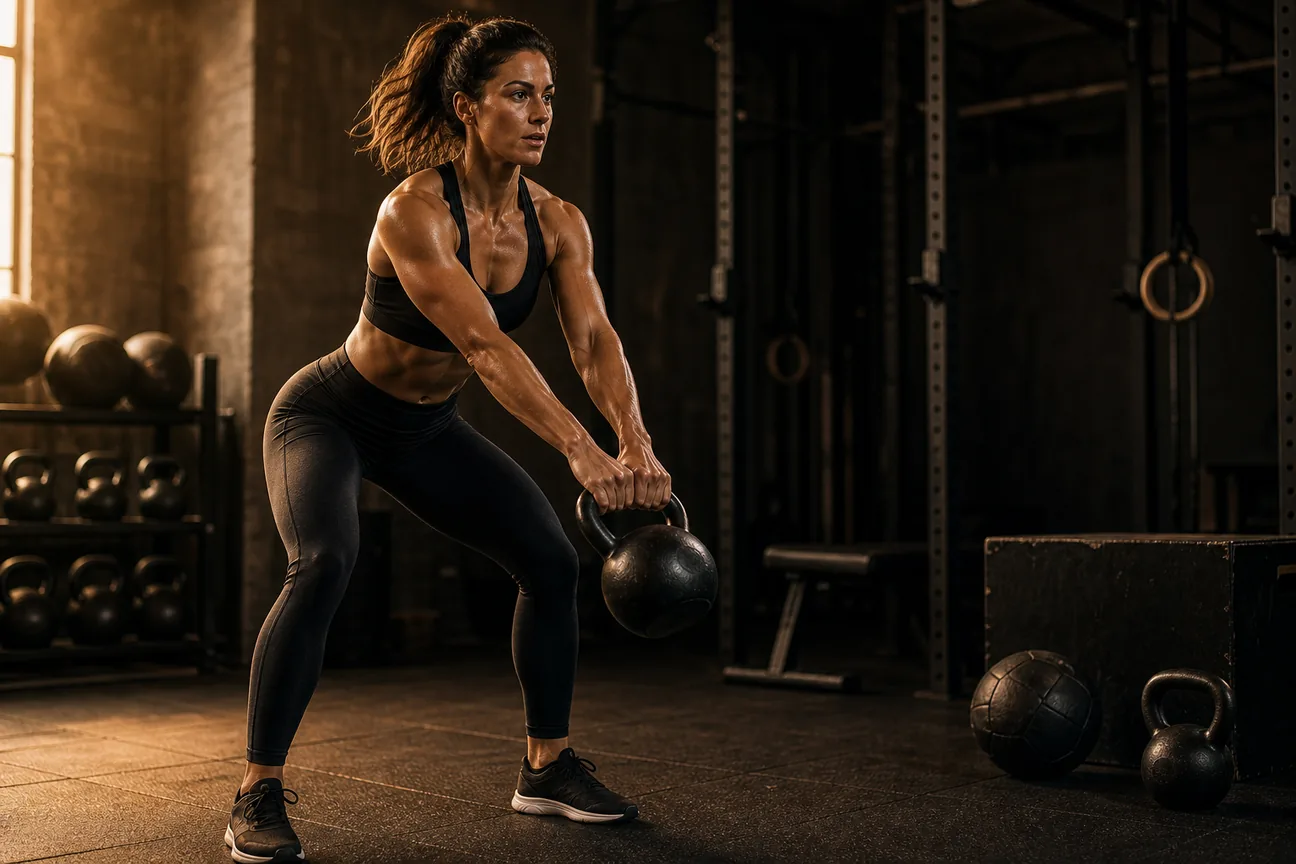
Grab one kettlebell and make your next short workout count. The best kettlebell strength workouts give you a clear plan, not another saved video to figure out later. Here are five formats with different time demands and goals, plus a quick way to pick one that fits your week.
An analysis of 65 comments and questions from YouTube, Reddit and Quora about kettlebell strength workouts found that 26% mentioned health improvements and therapeutic benefits.
1. Simple and Sinister, a minimalist two-exercise routine
Simple and Sinister is an open-ended routine built around kettlebell swings and Turkish get-ups. It suits you if you want a repeatable session with very little setup and can practice the same two skills over time.
A swing is a hip hinge: send your hips back, then snap them forward to move the bell. Your arms guide it; they don't lift it like a front raise. A Turkish get-up takes you from lying on the floor to standing while holding the kettlebell overhead. Move slowly and keep your eyes on the bell while you learn the positions.
The routine keeps the exercise menu short, but it isn't a quick fix or a fixed six-week block. Simple and Sinister sessions run about 20 to 30 minutes and use one or two kettlebells. Its open-ended structure may work well if you like steady practice; it may feel repetitive if you need new movements to stay engaged.
Use a bell you can control through both movements. A get-up asks for shoulder control and balance, so don't pick your swing weight by feel alone. Start light enough to pause at each position without rushing. If you want a broader session plan, Hybrid Fit Mom's strength and conditioning program for women uses a wider mix of movements and a set six-week arc.
This is the spare, focused option. It rewards patience more than novelty.
2. 30-Day Pressing Program, a focused option for overhead strength
The 30-Day Pressing Program is a four-week plan built around a rep ladder. It fits you if pressing strength is a priority and you have a pair of matching kettlebells available.
The reported session length is 20 to 25 minutes. The ladder moves through one, two, then three reps, which gives you a simple way to organize each set. Keep the press strict: start with the bell in the rack position against your forearm, brace your middle, then press overhead without turning the movement into a knee drive.
That last cue matters. A push press uses the legs to help move the bell; a strict overhead press relies more on the pressing arm and trunk. Both have a place, but they're different tasks. If your ribs flare or your lower back arches as the bell rises, lower the load or stop the set. A clean rep is worth more than a forced one.
A matched pair is part of this plan's equipment need, so it's less minimal than a one-bell routine. It also has a narrower focus than a full-body plan. You can add goblet squats or deadlifts on other training days if you already know those patterns, but don't turn a pressing block into a grab bag of extra work.
Choose this format when overhead strength is the clear gap you want to work on. If pressing is new to you, practice the rack position with a light bell before following a timed session.
3. Aggressive Conditioning Program, high-volume swings with strength moves
The Aggressive Conditioning Program pairs swing sets with strength movements such as presses, goblet squats, and dips. It's a five-week conditioning-focused format for someone who already handles kettlebell swings well and wants a demanding session.
Its defining feature is a reported 500 swings per session. That's a high volume, not a sensible starting target for every trainee. Swings are ballistic: the bell moves quickly, and your hips create the force. When fatigue makes you squat the swing, round your back, or lose your grip, the session has outlasted your form.
Think of a hinge as closing a car door with your hips. Your knees stay soft, but the movement comes mainly from sending your hips back and driving them forward. Keep the bell close as it travels between your legs. Stop the set if you can't keep that shape. A lower rep count done well is a better choice than chasing a number while your form slips.
High-rep conditioning can take more time and attention than a simple timer suggests. Build up only if you already recover well from swing work. You can use shorter sets with rest between them. Don't assume you need to copy its full volume to get useful training.
This one is for experienced swing practitioners who want a tough conditioning challenge. If you're learning the hinge, pick a lower-volume format first.
4. The ABC Kettlebell Program, a phased six-week strength and conditioning plan
The ABC Kettlebell Program is a six-week plan with three phases: volume accumulation, density, then intensity. It suits intermediate trainees who can already clean, press, swing, squat, and row without coaching.
It calls for three sessions a week, each about 45 to 60 minutes. One kettlebell is required, with a second optional for advanced trainees. The longer sessions give room for several movement patterns, but they may be hard to fit around work, school pickup, or a week that changes at the last minute.
The plan's phases change the training demand over time instead of asking you to repeat one fixed workout. That makes it easier to see what the next block is meant to do. In the early weeks, focus on clean reps and a steady pace. Later, a denser session means doing similar work with less rest, not rushing through sloppy reps.
For your own warm-up, spend a few minutes rehearsing the shapes you're about to load: bodyweight hinges, unloaded squats, and gentle shoulder circles. Then do a few light deadlifts or presses before the work sets. Afterward, walk until your breathing settles and use easy stretches for hips and shoulders. Windmills and halos can help you practice control, but keep them light and smooth.
Hybrid Fit Mom's six-week plan takes a different route for busy women and mothers: it has four sessions a week, one kettlebell, prerecorded demonstrations, and an eating framework. The listed program details describe three sessions of 30 to 40 minutes and a short core session of about 20 minutes, which may be easier to schedule than a 45-to-60-minute workout.
5. Kettlebell KUTS, video-led sessions for busy adults
Kettlebell KUTS is an online video program with sessions reported at 30 to 45 minutes. It's a fit if you like following a coach on screen and prefer a session that tells you what to do as you train.
Video can help you keep moving without stopping to plan each exercise. But a video workout and a progressive plan aren't the same thing. Look for a clear way to build the work over time: more controlled reps, a heavier bell when you're ready, or less rest while keeping your form steady. If you simply repeat the same session at the same effort, it may not meet a goal of getting stronger.
A single bell can cover a full-body session. Swings train the hinge; goblet squats load the legs; rows work the back. A clean and press combines a smooth rack position with an overhead press. Thrusters add a squat before the press, so use them only when both parts feel sound. Overhead presses build a steadier, slower challenge, while the Turkish get-up asks for control through several positions.
Some video workouts use timed intervals, such as 30 to 40 seconds of work followed by 20 to 30 seconds of rest. That's a useful format for conditioning, but the clock shouldn't force you to rush a technical move. For get-ups, cleans, or snatches, take the time you need to do each rep well.
Choose a bell that lets you keep control on the hardest movement in the session, not only the easiest one. If your grip opens or you can't hold a stable rack, pause and adjust. Kettlebell KUTS is the video-led choice here; decide separately whether you want a fixed progression or a library of sessions.
Kettlebell Strength Workouts Compared
Use the table to match the format to the time you have and the skill you want to build. The table gives session lengths and equipment for each workout.
| Workout | Time or schedule | Equipment | Best fit |
|---|---|---|---|
| Simple and Sinister | About 20–30 minutes, open-ended | One or two kettlebells | Repeat practice with two movements |
| 30-Day Pressing Program | About 20–25 minutes, four weeks | Pair of matching kettlebells | Focused overhead strength work |
| Aggressive Conditioning Program | Five weeks | One kettlebell | Experienced trainees who want high swing volume |
| The ABC Kettlebell Program | Three days weekly, 45–60 minutes, six weeks | One kettlebell, second optional | Intermediate trainees who want phased training |
| Kettlebell KUTS | About 30–45 minutes | Kettlebell | People who prefer video-led sessions |
For a busy schedule, time alone doesn't tell you whether a plan will be easy to follow. Check the workout days, how each session progresses, and whether you can fit the whole session into your real week. Hybrid Fit Mom is a self-guided six-week option with one payment and lifetime access, plus prerecorded demos and an eating framework.
FAQ About Kettlebell Strength Workouts
What kettlebell weight should I start with?
Start with a bell you can control through the exercises in your plan, using clean form. You may find that a weight feels fine for a deadlift but too heavy for an overhead press. Test the hardest movement with a few easy reps before starting a timed workout. Increase the load only when you can keep the same control from the first rep to the last.
Can one kettlebell give me a full-body workout?
Yes, one kettlebell can train the whole body when the session includes different movement patterns. A plan might pair a hinge such as a swing or Romanian deadlift with a goblet squat, row, and press. The key is to use movements you can do safely and to make the work gradually harder over time. A single bell doesn't mean every exercise needs the same load.
How often should I do kettlebell workouts?
Follow the schedule in the program you choose, then leave room to recover between harder sessions. Simple and Sinister is an open-ended practice, while the ABC plan uses three weekly sessions. Your available time matters, but so does how you feel during the next workout. If soreness or fatigue changes your form, reduce the work or take more rest.
Are timed kettlebell intervals good for strength?
Timed intervals can help organize a short workout, especially when the exercises are familiar and easy to control. For example, a session might use 30 to 40 seconds of work followed by 20 to 30 seconds of rest. But a timer doesn't guarantee strength gains. Track reps and load, then add difficulty in small steps while keeping each rep clean.
How can I make kettlebell training safer?
Learn the hinge before doing fast swings, and keep the bell close to your body during cleans. Set it down with control when you need a break. For overhead work, brace your middle and avoid arching your back to finish a rep. Warm up with easy versions of the moves you'll train. Stop if sharp pain occurs rather than trying to push through it.
Conclusion
If you want a defined home plan that accounts for a busy week, start with a six-week schedule you can repeat consistently. Hybrid Fit Mom's program has one kettlebell, filmed movement demos, an eating framework, and lifetime access after a one-time purchase. Review the session details, choose a bell you can control, then set your first training days on the calendar.